

I scored 85% on a practice bank and walked into the Service Cloud Consultant exam feeling fine. Then the second question handed me four answers that would all technically work and asked which was the MOST cost-effective. I sat there longer than I want to admit.
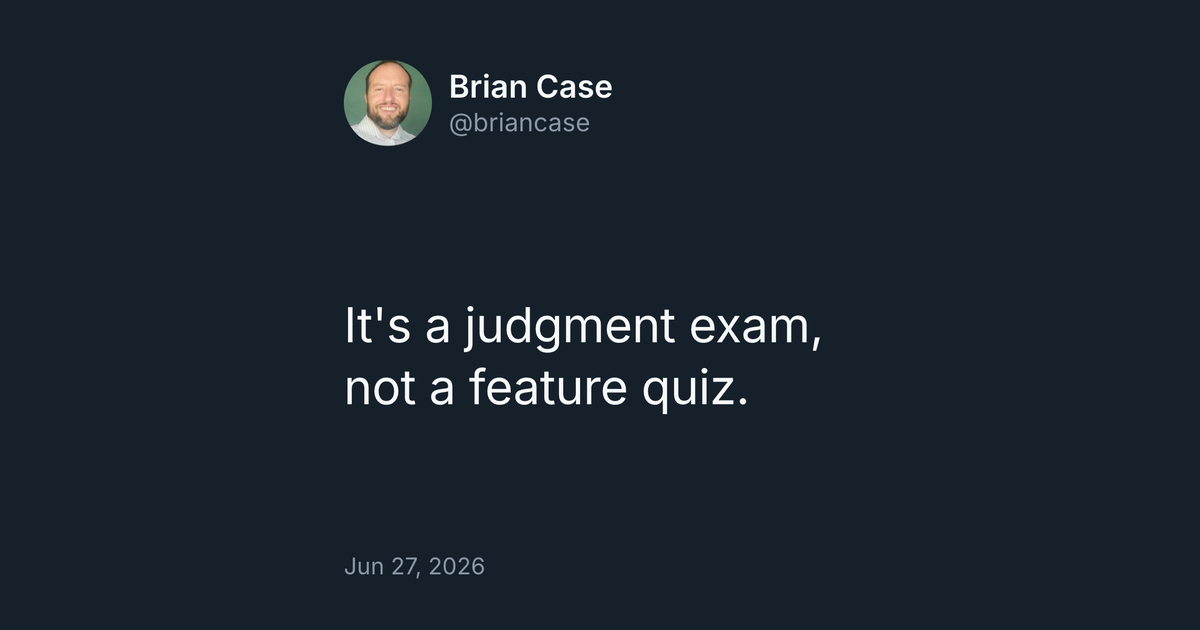
That is the whole exam. It is not a feature quiz; it is a judgment exam.
So, the honest answer: yes, it is hard, and widely considered one of the harder core Salesforce certs. But "hard" is not the same as "long," and how much you need to study depends almost entirely on what you already do all day.
Why it has the reputation
Most people meet this exam after passing the Administrator credential (which you need first) and maybe Sales Cloud Consultant. Both go down easy by comparison, and that is exactly the trap.
Sales Cloud overlaps heavily with Admin knowledge (leads, accounts, opportunities, forecasting), so many people pass it with light study. Service Cloud is mostly net-new territory: contact-center operations, telephony, omni-channel routing, SLAs. Your Admin pass does not carry you here, and overconfidence is a top reason people fail the first sitting. People who hold a stack of certs sometimes rank its conceptual load near CPQ or Sharing and Visibility.
What actually makes it hard
Not the logistics: sixty scored questions, 105 minutes, about two-thirds to pass, 200 USD. That is roughly 96 seconds per question, fine until you meet the stems.
The stems are long and scenario-based, padded with deliberate distractors: irrelevant business detail dropped in to mislead anyone skimming. Then you get several options that would all do the job, and the exam asks for the best one. The differentiator is often a single qualifier word: MOST scalable, FIRST step, LEAST effort. Miss it and you confidently pick a "correct" answer that is still wrong.
And the format drifts: historically multi-select, but recent sittings report more single-best-answer items with no partial credit.
The domains that trip people up
A few areas show up again and again in the "what got me" stories.
Omni-Channel routing. Queue-based versus skills-based is the classic confusion. When the scenario mentions language, a specific skill, or a specialized agent, it is steering you toward skills-based routing. When agents manually pull from a pile, that is assignment rules, not Omni-Channel. Know presence statuses and capacity models too.
Entitlements, Milestones, SLAs. The single most-cited source of pain. Treat it as a sequential build: entitlement process, then milestones, then milestone actions, then attach the entitlement to the case (a case will not track an SLA until one is). And know when a plain age-based escalation rule is enough versus when you genuinely need an entitlement process for contractual SLA tracking.
Knowledge. Classic versus Lightning Knowledge (Lightning uses one article type with record types), plus migration gotchas around attachments and article numbers. Know when visibility is handled by Data Categories versus standard sharing.
Telephony. Open CTI integrates an existing phone system into the console; Service Cloud Voice is native telephony with transcription, often on Amazon Connect. Recent exams lean harder on Voice than older study guides prepared people for.
The emerging stuff. Incident Management (linking many cases to one incident during a mass disruption), Workforce Engagement (forecasting and scheduling agents), and data-privacy topics like GDPR and CCPA. These blindside anyone who studied an older guide.
One mercy: Field Service overlap is minimal, so skip Work Orders, scheduling, and Gantt charts. This exam stays in the contact-center lane.
Why people fail the first time
They over-rely on practice banks. You can score in the mid-80s on a bank and still fail: the real exam tests consulting judgment, while banks reward feature recall and sometimes blur Classic versus Lightning. Use them as a diagnostic, not the whole plan.
They skip the official Limits and Considerations docs. The exam loves the edge case where the obvious feature is quietly ruled out by a volume, sharing, or licensing limit buried in the prompt.
And they sit too early on an Admin or Sales Cloud pass, without enough contact-center reps.
Hands-on beats theory
This exam targets the judgment you build from years of real implementation work. Under time pressure, visual memory wins: people who have actually built the console, configured an entitlement process, and set up omni-channel routing eliminate wrong answers faster, because they remember what the screens and gotchas felt like.
If you cannot get that on the job, manufacture it. Spin up a free Developer org and build the things. The official Trailhead trailmix plus the Service Cloud Specialist Superbadge are the most-recommended path, because the superbadge makes you configure from vague requirements, exactly what the exam simulates.
How much prep to actually budget
Be honest about which bucket you are in.
Brand-new to Salesforce: realistically 4 to 9 months total. You have to earn the Administrator credential first (3 to 6 months), then spend 2 to 3 months on Service Cloud, heavy on hands-on.
Experienced admin, little Service Cloud: roughly 6 to 8 weeks at 15 to 20 hours a week, focused on the net-new contact-center concepts: CTI and Voice, omni-channel, Knowledge migration, entitlements and SLAs.
Working Service Cloud consultant who configures it daily: about 2 to 4 weeks filling gaps outside your daily scope (analytics and KPIs, Incident Management, the omni-channel limits you never hit in practice).
For a week-by-week plan built for the experienced-admin profile, I wrote a companion piece on how to pass this exam.
One universal readiness gate: consistently score around 80% on reputable timed practice before you book. That is a comfortable buffer over the roughly two-thirds pass bar, and cheap insurance.
On exam day, triage. If a scenario is a knot, make an educated guess, mark it for review, and move on. Never leave anything blank; there is no penalty for guessing.
Pressure-test before you book
Knowing the difficulty is half of it; knowing where you are weak is the other half. Before you spend the 200 USD, run a free Service Cloud Consultant practice exam, no sign-up required, and see whether you clear that 80% line under time pressure. The questions you miss tell you exactly where to focus.
Hard exam. Very passable. Budget by your background, build the thing with your own hands, and read the qualifier word twice. Good luck.