

Most people who fail the MuleSoft Integration Architect exam fail before they even book the date. They study for the wrong test.
I have seen brilliant engineers walk into the testing center expecting to design an API, only to walk out humbled by a gauntlet of non-functional requirements. Worse, some memorize organizational governance strategies that belong to a different credential.
Let us get the alphabet soup out of the way first. The MuleSoft Certified Developer (MCD) credential is for tactical build skills; you design flows, write syntax, and get the job done. The MuleSoft Certified Platform Architect (MCPA) is about macro strategy; you stand up a Center for Enablement and define governance rules.
This credential, officially the Salesforce Certified MuleSoft Platform Integration Architect (formerly the MCIA-Level-1), sits right in the middle. It tests micro-architecture. It asks how your integration survives when the network blinks, the payload spikes, or the memory runs dry.
The logistics are straightforward. You have 120 minutes to answer 60 scored questions, plus up to 5 experimental ones. You need a 70% to pass. It costs $400, includes one complimentary retake, and remains valid for two years.
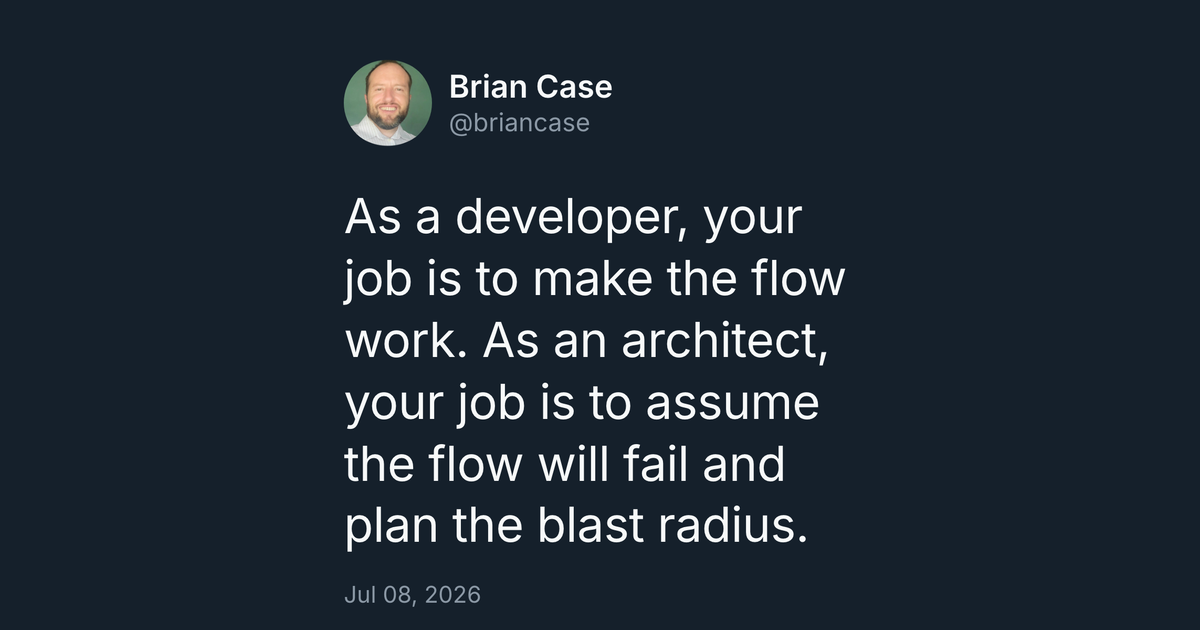
But the exam style is anything but straightforward. As a developer, your job is to make the flow work. As an architect, your job is to assume the flow will fail and carefully plan the blast radius. You have to unlearn your tactical instincts to pass. Our free MuleSoft Integration Architect practice exam is built from these same non-functional-requirement scenarios, so it is the fastest way to feel that shift before you spend the $400.
Here are the six developer habits you have to break.
Habit 1: Treating all clouds the same
The Developer Habit: Assuming "CloudHub" is just one homogeneous deployment target.
The Architect Reality: The gap between CloudHub 1.0 and 2.0 is a canyon, and the exam exploits it mercilessly.
CloudHub 1.0 isolates your application on a dedicated EC2 Worker inside an Anypoint VPC. If you need a custom domain or inbound mTLS, you map a Dedicated Load Balancer (DLB) to that VPC. Each application needs its own static IP for external whitelisting.
CloudHub 2.0 changes the physics of the platform. It runs containerized Replicas on Kubernetes. The isolation boundary is now a Private Space, and a managed, auto-scaling Ingress replaces the DLB. Failing to spot the difference is fatal on exam day. If a scenario requires granular vCore scaling (like 0.1 or 0.5 vCores) and mentions a shared pool of outbound static IPs managed by egress firewall rules, you are in 2.0 territory.
If the scenario demands strict data-sovereignty where Mule runtimes must run on the customer's own hardware while remaining tied to the Anypoint control plane, you are looking at Runtime Fabric (RTF).
Verdict: Map the topology constraint to the exact deployment model. They are not interchangeable.
Habit 2: Slapping a VM queue on everything
The Developer Habit: Reaching for a VM queue the second a process needs to be asynchronous.
The Architect Reality: VM queues are strictly internal. They live inside the local runtime or the cluster's memory grid. If you need decoupled publish-subscribe messaging across independent Mule apps, or if you need to route messages to external non-Mule systems, VM queues are the wrong answer. You need Anypoint MQ.
Then the exam tightens the screws. You know you need Anypoint MQ, but do you need strict global ordering or massive throughput? Anypoint MQ FIFO queues guarantee the order, but they choke your concurrent in-flight throughput. If the requirement demands speed over strict sequencing, a partitioned external broker like Apache Kafka trades global ordering for velocity.
Verdict: Let the non-functional constraint dictate the queue type. Never use an internal queue for an external problem.
Habit 3: The retry reflex
The Developer Habit: Wrapping every brittle API call in an Until-Successful scope.
The Architect Reality: Until-Successful is a flow-level bandage for transient application failures. It works fine when a downstream REST API throws a temporary HTTP 503 during a traffic spike.
But what happens when the external JMS broker goes offline for a ten-minute maintenance window? An Until-Successful scope just wastes threads trying to cross a broken bridge. That scenario demands a Reconnection Strategy configured globally at the connector level. Reconnection strategies handle the actual socket lifecycle and can hold off until the infrastructure recovers.
Verdict: Use scopes for application hiccups and connector strategies for infrastructure outages.
Habit 4: Ignoring the heap
The Developer Habit: Assuming DataWeave handles memory management magically.
The Architect Reality: A developer sees a massive JSON payload as data. An architect sees a memory trap wearing a JSON mask.
DataWeave keeps small payloads in fast, off-heap buffers. But once a payload crosses roughly 1.5 MB (exactly 1,572,864 bytes), it spills that buffer to local disk in temporary files. If you try to sort or aggregate a multi-gigabyte CSV on a fractional vCore worker without reactive streaming, the runtime will exhaust the heap and crash.
The exam loves distractors that are functionally perfect but architecturally doomed. A transformation that processes a massive array entirely in memory is a trap. The correct answer usually involves deferred streaming (e.g., output application/json streaming=true) or Batch Job scopes that chunk the data into persistent records processed asynchronously.
Verdict: If the data is big, stream it or batch it. Never hold it all in memory.
Habit 5: Mixing up security and state
The Developer Habit: Hardcoding passwords to get the build green and throwing rate limits wherever they are easiest to configure.
The Architect Reality: Security and state distribution require precision.
Consider the Idempotent Receiver pattern. You use an idempotent-message-validator to track unique message IDs in an Object Store so you do not process a duplicate payment. But on a multi-worker CloudHub setup, that Object Store must be shared so all workers see the same state. This requires Object Store v2 (persistent and cloud-based).
For API protection, you must know the difference between Rate Limiting and Spike Control. Rate Limiting hard-rejects requests over a cap. Spike Control queues excess requests and processes them slightly later.
And if an exam option suggests putting a cleartext password in a config file, eliminate it immediately. You need the Mule Secure Configuration Properties module, encrypted with AES, with the decryption key supplied as a hidden deployment variable.
At the perimeter, know the layers too: TLS 1.2 or 1.3 for data in transit, OAuth 2.0, JWT validation, or Client ID Enforcement for access, and JSON Threat Protection to reject maliciously deep payloads before they crash a parser. "Can this caller in?" and "can this payload hurt the runtime?" are two different questions with two different policies.
Verdict: Protect the perimeter deliberately, and sync your state across the cluster.
Habit 6: Dumping everything in the System layer
The Developer Habit: Treating API-led connectivity as three folders to sort code into, then defaulting most things toward the System layer because that is where the database lives.
The Architect Reality: The layer is a design decision, not a filing system. A System API exists to protect and abstract a system of record, so it should stay stable, reusable, and thin. Consumer-specific caching and broad consumer-facing rate limits usually belong higher up, at the Process or Experience layer, where they can flex per consumer without welding that logic onto the system of record. When a scenario hands you a cache or a policy and asks where it goes, ask what each layer is actually for: protecting a backend, orchestrating a process, or shaping one consumer's experience.
Verdict: Place logic by intent, not by proximity to the database.
Building a 10-12 Week Study Plan
You cannot wing this exam. A standard timeline for an engineer with six to twelve months of MuleSoft development experience is 10 to 12 weeks.
Spend weeks one through three mastering runtime topologies (CloudHub 1.0 vs 2.0 vs RTF, VPCs, Private Spaces, DLBs, and Ingress). Spend weeks four through six on async messaging and reliability (VM vs MQ, Until-Successful vs Reconnection, Idempotency). Dedicate weeks seven and eight to performance and security (DataWeave memory thresholds, streaming, OAuth, and secrets). Use the final weeks to master CI/CD automation. The Mule Maven Plugin and MUnit are the tools that allow you to move fast safely; know how the pom.xml targets different environments and how MUnit catches regressions.
The single most important study decision you will make is taking the official "Anypoint Platform Architecture: Integration Solutions" course. Do not take the "Application Networks" course by mistake; that one maps to the MCPA.
Skip the basic drag-and-drop tutorials. They build simple flows without enterprise constraints and give you false confidence. Avoid free internet dumps; they are notoriously filled with wrong answers. Instead, read the official MuleSoft whitepapers on Anypoint MQ FIFO limits and CloudHub 2.0 Ingress routing.
The Architect's Exam-Day Playbook
When you sit for the test, the clock is your biggest enemy. You have about two minutes per question, and these are long, paragraph-heavy scenarios.
Read the actual question at the very end of the paragraph first. Then read the scenario looking for the specific constraints. Does it say "occasional" duplicate or "persistent" failure? Does it specify a "single worker" or a "multi-node cluster"? A single adjective changes the correct answer.
On the multiple-select questions without partial credit, your choices must be technologically complementary. You cannot pick "single worker" and "cluster configuration" simultaneously.
Finally, look out for impossible combinations. Some distractors invent feature pairings that simply do not exist in the platform, like attaching an Anypoint VPC to CloudHub 2.0, or using a VM queue to talk directly to an external SAP system. Those are free eliminations.
The Final Pivot
Passing this exam changes how you look at the platform. You stop thinking about how to build the integration and start thinking about how to protect it. At Bridge GPT, our core philosophy is to architect more and code less. When you rely on strict specifications and resilient design patterns, the actual coding becomes the easy part.
When you are ready to test your baseline, you need a way to find your blind spots without risking the $400 testing fee. We built a free resource to simulate these exact architectural trade-offs. You can take our MuleSoft Platform Integration Architect practice exam to see if your architect filter is working.
Run the numbers, find your gaps, and go build something resilient.