

I looked at the MuleSoft certification list a few years ago when planning my own career progression and realized something funny. The names are actively trying to confuse you.
You have the Platform Architect exam and the Platform Integration Architect exam. They sound like the exact same job. They test entirely different things. Guess wrong, and you will spend weeks studying for a test you are entirely unqualified to take.
Getting certified on MuleSoft is an expensive hobby if you go in blind. The exams are challenging, the retake fees add up fast, and the ecosystem shifts under your feet. You need a map.
If you are brand new to this space and just want to know where to start without burning cash on prep materials, you can jump straight to our free MuleSoft Integration Foundations practice exam. If you want to know how the whole ladder works before you commit, keep reading.
Here is the actual, practitioner-tested roadmap for navigating MuleSoft certifications in 2026.
The Urgent Warning: What to Skip Entirely
Let us start with what you should avoid. This is highly time-sensitive.
Salesforce is cleaning house. They are retiring two specific MuleSoft credentials on February 1, 2027. The Salesforce Certified MuleSoft Catalyst Consultant and the Salesforce Certified MuleSoft Hyperautomation Developer are going away permanently.
If you are currently studying for either of these, pay very close attention to the timeline. July 24, 2026 is the absolute last day you can register for them. August 31, 2026 is the final day to actually sit for the test.
My advice? Do not start studying for either of these right now unless you can realistically pass the exam before that August 31 deadline. If you miss the window, your effort is wasted. A retired certification looks perfectly fine on a resume if you earned it three years ago, but it is a terrible investment of your time today. Pivot to a durable credential instead.
The Core Rule: Build vs. Decide
Before we look at the specific certifications you should take, we need to clear up the biggest misunderstanding in the ecosystem. It comes down to what the testing engine is actually trying to measure.
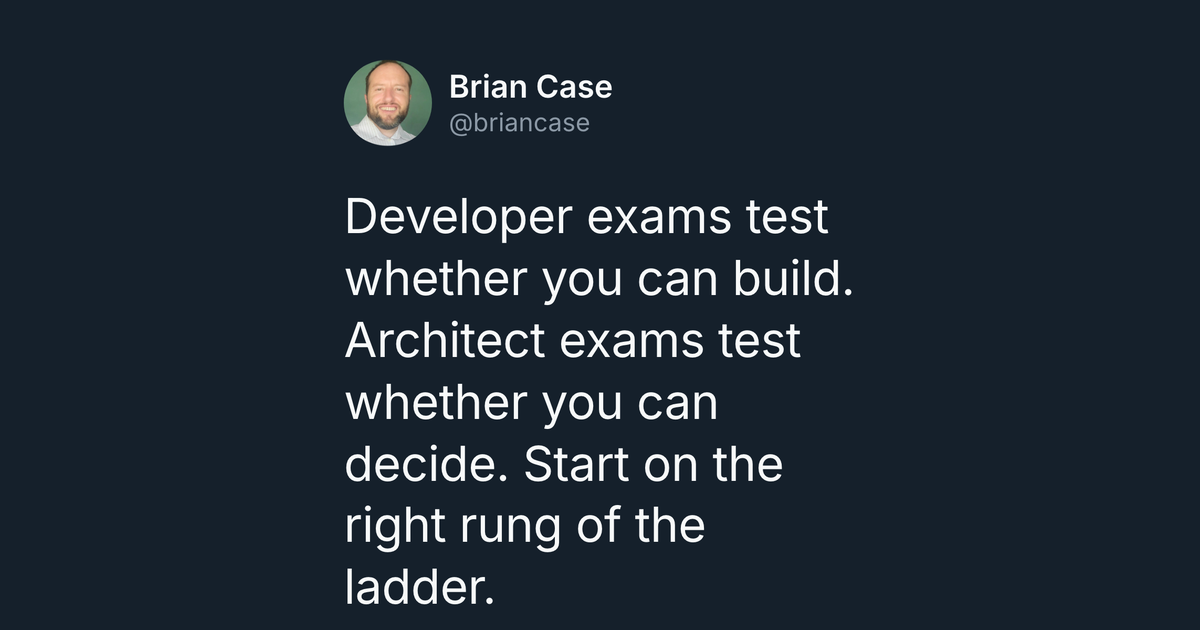
Developer exams test whether you can build.
Architect exams test whether you can decide.
A developer credential wants to know if you can write the DataWeave script, configure the HTTP connector properly, and deploy the application without breaking the build. It is about execution.
An architect credential assumes you already know how to build the API. It wants to know if you can make the right trade-offs regarding deployment topology, high availability, and network throughput. It is about making the hard choices that dictate how the system behaves under stress.
Keep that mental model in your head. It dictates the entire order of operations.
The 2026 MuleSoft Certification Ladder
There is a smart sequence to these exams. Skipping rungs usually results in a failed test and a bruised ego.
Rung 1: Integration Foundations (The On-Ramp)
Do not jump straight into the Developer exam. Your first stop is Integration Foundations.
This is the entry-level credential. It does not expect you to write complex code or debug a failing pipeline. Instead, it proves you understand API-led connectivity, core integration terminology, and the basic components of the Anypoint Platform.
This exam is built for business analysts, project managers, and junior developers who need to prove they can contribute to a MuleSoft project without needing their hand held on vocabulary. Do you know the difference between a System API, a Process API, and an Experience API? That is what this test measures.
It is also the cheapest, lowest-friction way to confirm this ecosystem is actually a good fit for your career.
Want to know what the testing experience feels like? We put together a guide covering how hard the Integration Foundations exam actually is. When you are ready to prepare, read our breakdown on how to pass the Integration Foundations exam, and then run through our practice questions to validate your knowledge.
Rung 2: MuleSoft Developer Level 1 (The Core Builder)
Once you know the vocabulary, it is time to build.
The Salesforce Certified MuleSoft Developer credential is the core hands-on requirement for practitioners. Almost every junior to mid-level MuleSoft engineering role asks for this exact certification.
It covers the actual mechanics of Anypoint Studio. You will be tested heavily on DataWeave fundamentals, routing, error handling, and how to design, test, and debug basic APIs. The questions will give you a specific scenario and ask for the right Mule component or the correct DataWeave syntax. You have to know the tool intimately.
We built a free MuleSoft Developer practice exam for this specific tier. Use it to find your weak spots before you pay the official registration fee. If you consistently fail the DataWeave questions on our practice test, go read the official docs before you sit for the real thing.
Rung 3: MuleSoft Developer II (The Veteran)
This is for the seasoned builders.
Developer II is meant for engineers working independently on production-ready applications in a mature DevOps environment. You need real, painful, hands-on experience for this. Do not try to memorize your way through it immediately after passing Level 1.
You will be tested on CI/CD pipelines, custom connectors, advanced DataWeave transformations, and performance tuning. Build real APIs for six to twelve months first. (Note: we do not currently offer a practice exam for Developer II, so rely heavily on the official Trailhead modules when you reach this step).
Rung 4: The Architect Fork (MCPA vs. MCIA)
Here is where smart people make expensive mistakes.
After 6 to 12 months of delivery experience, most practitioners look at the architect track. You will see two options staring back at you. Platform Architect (MCPA) and Platform Integration Architect (MCIA).
They sound like the same job. They are not.
Platform Architect (MCPA) defines the organization-wide strategy. This is about application networks, API-led connectivity at a massive scale, and setting up a Center for Enablement (C4E). It is heavily focused on governance. The MCPA is the whiteboard.
Platform Integration Architect (MCIA) is the technical design counterpart. It translates functional requirements into concrete integration designs. This exam tests your ability to design for high availability, throughput, reliability, and security. The MCIA is the server rack.
The MCIA is a beast of a test. You get 60 questions and 120 minutes. You need a 70% to pass. It costs $400, though that usually includes one free retake. You have to know your non-functional requirements cold. A bad architecture leads to a bad implementation. It is a garbage in, garbage out scenario.
If your future is strategy and API programs, take the MCPA.
If your future is hard technical design and deployment topology, take the MCIA. Many senior architects eventually pursue both because they cover complementary halves of the job, but do not study for one thinking it is the other.
If you choose the technical route, start by reading our guide on how to pass the Platform Integration Architect exam. After that, stress-test your knowledge using our free Platform Integration Architect practice exam.
The 2026 Durable Certification Lineup
To keep it simple, here is the current state of the board.
| Certification | Tier | Who it is for | Status |
|---|---|---|---|
| Integration Foundations | Entry | Analysts, PMs, junior devs needing vocabulary | Durable |
| MuleSoft Developer (Level 1) | Builder | Core developers building and testing APIs | Durable |
| MuleSoft Developer II | Builder | Senior developers handling DevOps and prod | Durable |
| Platform Architect (MCPA) | Architect | Leaders owning org strategy and governance | Durable |
| Platform Integration Architect (MCIA) | Architect | Technical leads designing for HA and throughput | Durable |
| Catalyst Consultant | Specialized | N/A | Retiring Feb 2027 |
| Hyperautomation Developer | Specialized | N/A | Retiring Feb 2027 |
How to Actually Prepare
You can spend hundreds of dollars on third-party test prep. I did when I started my career. Most of it is just repurposed official documentation wrapped in an expensive paywall.
We built our free practice exams because we got tired of seeing smart practitioners pay for low-quality mock tests. Every practice exam we offer is genuinely free. We do not gate them behind an email sign-up. You get unlimited attempts.
Best of all, every single question links directly to the relevant Trailhead module in the explanation. When you get an answer wrong, the test points you exactly to the official documentation you need to read.
A practice exam is not just a thermometer to check your score. It is a diagnostic tool. Run a session, find the three topics where you consistently guess blindly, and go study those specific concepts.
The Bigger Picture
The MuleSoft certification path is straightforward once you strip away the confusing names and the expiring credentials. Learn the vocabulary, learn to build the APIs, and then learn to design systems at scale.
As you move up that ladder, you will start noticing something fundamental about the way we build software. We spend a massive amount of time writing repetitive boilerplate code that we already know how to write.
This is why Bridge GPT exists. We build a spec-driven development platform for Salesforce Commerce Cloud, and our core philosophy is simple: architect more, code less. We believe humans should do the high-level decision making (the architect work) while AI handles the execution (the developer work). By plugging directly into tools like Jira and GitHub, Bridge helps teams move fast safely, turning well-defined requirements into pull requests without the busywork.
But tools only amplify your existing knowledge. To use AI effectively, you still need to know how the underlying systems behave. Great instructions lead to great output. Poor instructions lead to incorrect output.
If you are mapping out your certification path for the rest of the year, take it one step at a time. Ignore the expiring consultant exams. Start at the bottom of the ladder and earn your way up.
Go take our free MuleSoft Integration Foundations practice exam right now and see exactly where you stand.